
*The Unicorn's Table, Paris, c. 1500 - The Spicekeeper's Almanac - Issue Six

Updated: Jul 14
"A memorable meal is never remembered for food alone."
Michel

Welcome
"The first course of every memorable supper is anticipation."
Welcome, my friend. I'm delighted you've joined me.
Pull your chair a little closer, and if you've brought a cup of tea, let it grow comfortably warm in your hands. Tonight, our journey carries us to Paris around the year 1500, where one of the greatest artistic treasures of the late Middle Ages still waits to tell its story. Before the candles burn low, before musicians lift their instruments, and before the first course is carried into the hall, I'd like us to arrive while the evening is still quietly preparing itself.
I have often found that history speaks most clearly before the feast begins.
Once the tables are filled, our attention naturally turns toward the guests, the conversation, and the dishes placed before them. Yet long before anyone takes a seat, another story has already unfolded. Someone has risen before dawn to bake the bread. Someone has polished the cups until they catch the candlelight. Someone has gathered herbs from the garden, trimmed the candlewicks, laid fresh linen upon the table, and tasted the broth one final time before it leaves the kitchen.
History rarely remembers their names.
Yet every memorable table has depended upon their care.
History usually introduces us to kings, queens, generals, and magnificent cathedrals. They deserve their place, but they have never been the reason I travel to another century.
I have always believed that history is just as likely to be found beside a hearth as upon a throne. I wonder about the cook who rose before dawn to knead the bread, the steward who counted the wine casks one last time, and the gardener who gathered herbs while the morning dew still rested upon the leaves. Their names have almost entirely disappeared from history, yet every memorable feast depended upon their quiet work.
Perhaps that is why I have always been drawn to tables.
Around them, the great and the ordinary met for a few precious hours. A king and a baker might never have shared the same life, but both understood the comfort of warm bread, good company, and a generous welcome.
The story we share this evening begins with one of the greatest treasures to survive from the closing years of the Middle Ages: a magnificent series of six tapestries known today as The Lady and the Unicorn. They have become famous for their extraordinary beauty, but I have long suspected they tell us something equally important about hospitality.
Before we stand before them, however, we must first understand the remarkable city that gave them life.

Paris at the Turn of the Sixteenth Century
Paris around the year 1500 stood at the heart of the Kingdom of France and ranked among the largest and most influential cities in Europe. With perhaps two hundred thousand inhabitants, it was a place where commerce, scholarship, religion, and craftsmanship met within a maze of winding streets that stretched along both banks of the Seine.
Merchants crowded the city's bridges and marketplaces with cloth from Flanders, wines from Burgundy, fish carried inland from the coast, and spices that had traveled thousands of miles through Mediterranean trade. Bakers filled the streets with the aroma of fresh bread while blacksmiths, leatherworkers, goldsmiths, parchment makers, and countless other craftsmen worked behind open shopfronts that spilled their sounds and activity into the narrow lanes beyond.
The University of Paris attracted scholars from across Europe, making the city one of Christendom's great centers of learning. Monasteries and churches shaped the rhythm of daily life as much as the markets did, their bells marking the passing hours from dawn until nightfall. Every district possessed its own character, yet all were connected by a constant movement of people carrying goods, ideas, and stories through the bustling capital.
Paris also stood at an interesting moment in history.
The Middle Ages had not yet faded into memory, but the Renaissance had begun quietly reshaping art, architecture, learning, and courtly life. Gothic churches still dominated the skyline, illuminated manuscripts continued to be copied by hand, and medieval traditions remained deeply rooted. At the same time, printed books were becoming increasingly common, artists were experimenting with new ideas arriving from Italy, and the world beyond Europe's borders seemed to grow a little larger with each passing decade.
Within the homes of prosperous merchants and noble families, hospitality was both an obligation and an art. A well-appointed table reflected not only wealth but character. Guests judged a household by its welcome as much as by its menu. Clean linen, polished serving vessels, warm bread, fragrant herbs, orderly surroundings, and gracious conversation all spoke quietly of a family that valued generosity.
Whenever I visit an old house, whether only in imagination or through the pages of an inventory, I find myself looking first toward the hearth. A fire tells you whether a room was meant merely to impress its guests or truly to welcome them. A welcoming home is rarely remembered for its size. It is remembered for its warmth.
That thought has stayed with me for many years.
People often tell me about the finest meal they have ever eaten. They begin by describing a roast prepared to perfection, an unforgettable loaf of bread, or a dessert they have spent years trying to recreate. Yet if I ask them to linger a little longer in the memory, something remarkable happens.
They stop talking about the food.
They remember the room.
They remember the laughter.
They remember who was sitting beside them.
They remember how welcome they felt.
Perhaps that is because a memorable meal is never remembered for food alone. It is remembered because someone cared enough to prepare a place where others belonged.
Crossing the Threshold
Leaving the busy streets behind, one enters a very different world.
Outside, Paris continues its endless rhythm. Merchants gather the last of their wares before dusk, apprentices hurry to complete their errands, and carts creak beneath loads of grain, wine, and firewood. Church bells drift across the rooftops while smoke rises from hundreds of chimneys as households throughout the city begin preparing the evening meal.
The sounds are lively.
The streets are crowded.
The city rarely seems to pause.
Then the heavy wooden door closes behind you.
The noise softens.
The air grows warmer. Light from the hearth dances across timber beams as the fragrance of wood smoke, fresh bread, and herbs replaces the smells of the crowded streets. It is impossible to miss the feeling that someone has been preparing for your arrival long before you reached the door.
I often think these quiet moments are my favorite part of history.
Not the feast itself.
Not the speeches.
Not even the arrival of honored guests.
It is this brief pause when everything is ready, yet nothing has begun. The room seems to take one slow breath before it fills with conversation, laughter, and the joyful disorder of a shared meal.
Somewhere beyond the doorway, a cook gives one final taste to a simmering pot while servants make small adjustments that few guests will ever notice. A chair is moved into place. A candle is straightened. A serving platter is warmed beside the hearth.
These quiet acts rarely appear in history books.
Yet they are the unseen work of hospitality.
Only now are we ready to step farther inside.
The Great Hall
Now that we have stepped inside, our attention turns naturally to the room itself.
The great hall was far more than a place to dine. It was the heart of the household, where family gathered, visitors were welcomed, business was conducted, and life's important moments were celebrated. For a prosperous Parisian family around the year 1500, this room reflected not only wealth but character. It quietly expressed the values of the people who lived there long before a single word of welcome was spoken.
The first impression was one of warmth. A generous hearth occupied one end of the hall, its fire providing both comfort and light. Even when the weather was mild, a small fire often burned to soften the chill of stone walls and create an inviting glow as evening approached. As daylight faded beyond the windows, beeswax candles joined the fire, their steady light softening every shadow and enriching every color within the room. Faces appeared warmer, polished metal shimmered gently, and the hall itself seemed to encourage conversation. Candlelight has always possessed a remarkable ability to slow an evening, inviting people to linger just a little longer than they intended.
Only after taking in the warmth does the eye begin to notice the room itself. The furnishings were practical, yet beautifully crafted. Long oak tables could be assembled for feasts and removed when the hall served other purposes. Sturdy benches welcomed family and guests alike, while carved chairs with high backs were reserved for the master and mistress of the household or those honored with places of distinction. Large carved chests lined the walls, protecting valuable linens, serving vessels, silver, and treasured possessions until they were needed.
Although many people imagine medieval interiors as dark and somber, prosperous homes were often surprisingly colorful. Rich textiles softened stone walls while helping retain warmth during the colder months. Embroidered cushions, painted furnishings, carved woodwork, and polished metal reflected the glow of the fire and candles, creating an atmosphere that felt both comfortable and refined. Beauty was not an afterthought. It was part of the welcome.
The table itself spoke quietly of thoughtful preparation. Fresh linen covered the boards with careful precision. Polished cups stood waiting for wine. Knives, spoons, and serving dishes rested exactly where they belonged. Bread, still warm from the oven, lay beneath folded cloth to preserve both its fragrance and its warmth. Nothing appeared hurried. Everything suggested that the guests had been anticipated with care.
The hall appealed to more than the eye alone. Fresh rushes and fragrant herbs were often scattered across the floor, softening footsteps while freshening the room. Rosemary, sweet flag, and other aromatic plants mingled with the fragrance of wood smoke, warm bread, roasting meats, and herbs drifting from the nearby kitchen. Every breath reminded arriving guests that preparations had been underway long before they crossed the threshold.
Perhaps the most remarkable feature of the hall was not something one could see, touch, or even smell.
It was the feeling that everything was ready.
The busiest work had already been completed. The bread had been baked. The fire had been laid. The candles had been trimmed. The wine had been drawn. Servants moved with quiet confidence because preparation had given way to anticipation. For one brief moment, before the first guest crossed the room, the entire hall seemed to pause, holding its breath in quiet expectation.
I sometimes wonder if this is the moment I would most like to witness.
Not the feast itself.
Not the music.
Not even the conversation.
Just this single, peaceful moment when every careful task has been completed and hospitality waits patiently for the first knock upon the door.
It is in that stillness that our eyes finally begin to wander beyond the table.
Against the far wall hangs a series of tapestries unlike any other. Their crimson fields seem almost to glow in the candlelight, inviting every guest to look a little longer.
Only now are we ready to meet them.

The Lady and the Unicorn
There are works of art we admire. And then there are works of art that quietly begin asking us questions.
The Lady and the Unicorn has always belonged to the second kind.
Every time I return to these remarkable tapestries, I notice something different. Sometimes it is a flower I had overlooked. Sometimes it is the expression on the lady's face. Sometimes it is the unicorn itself, standing with such quiet confidence that it almost seems alive.
The finest works of art are never finished teaching us.
Today, the six tapestries are displayed in the Musée de Cluny in Paris, where visitors from around the world come to admire one of the greatest surviving masterpieces of late medieval art. Woven around the year 1500 from wool and silk, they remain astonishing not only for their beauty but also for the mystery they continue to preserve.
Art historians generally agree that the tapestries were commissioned by a wealthy member of the Le Viste family, whose crescent-shaped heraldic symbols appear throughout the series. Beyond that, much remains uncertain. We do not know precisely who conceived their remarkable symbolism, where they first hung, or what conversations they witnessed over the centuries. Like so many treasures of the Middle Ages, they have survived while much of their story has quietly disappeared.
Each tapestry unfolds against a brilliant crimson background covered with countless flowers in the millefleurs, or "a thousand flowers," style so beloved during the late Middle Ages. Birds perch among delicate branches. Rabbits nibble quietly beneath blossoms. Small monkeys play at the lady's feet while a majestic lion and an elegant unicorn stand faithfully at either side.
Every creature appears to have arrived for a purpose.
Nothing feels accidental.
Perhaps that is one reason these tapestries continue to reward careful attention more than five hundred years after they were woven.
For generations, scholars have agreed that five of the six tapestries represent the human senses. The sixth, bearing the mysterious inscription À Mon Seul Désir, continues to invite discussion and interpretation. Rather than offering simple answers, the series encourages us to reflect upon how human beings experience beauty, pleasure, memory, and ultimately one another.
As I have spent time with these remarkable works, I have found myself wondering whether they reveal something else as well.
Perhaps they also teach us about hospitality.
Hospitality Through the Six Senses
Hospitality begins long before food reaches the table. It begins the moment someone crosses the threshold.
The first tapestry celebrates sight. The lady gazes into a mirror held before the unicorn, reminding us that every welcome begins with what guests first see. They notice the room, the care taken in preparing the table, the warmth of the fire, the beauty thoughtfully woven into ordinary surroundings. Long before anyone tastes the meal, the eyes have already begun forming memories.
The second tapestry celebrates hearing. Music has accompanied hospitality for thousands of years, transforming ordinary gatherings into memorable occasions. Whether performed by skilled musicians or shared through cheerful conversation and laughter, sound creates the rhythm of every successful feast. Silence has its place, but shared voices remind us that no table is meant to be enjoyed alone.
The third tapestry turns to smell. Before the host appears, fragrance often announces that preparations have already begun. Fresh herbs scattered across the floor, beeswax candles, warm bread from the oven, wood smoke drifting from the hearth, and spices blooming gently in butter or oil all awaken anticipation (the blooming). Of all our senses, smell possesses an extraordinary ability to summon memory, carrying us home with a single familiar aroma.
Taste may seem the most obvious sense to celebrate at a feast, yet perhaps it is also the most misunderstood. A memorable meal is rarely remembered because it was extravagant. It is remembered because every element worked together. Fresh ingredients, thoughtful preparation, balanced seasoning, generous service, and unhurried conversation combined to create something greater than any single dish alone.
As I linger over these woven scenes, I find myself returning to one simple thought.
We rarely remember a meal because it was delicious.
We remember it because someone made us feel welcome.
A favorite dish may fade with time, but the feeling of belonging around a thoughtfully prepared table has a remarkable way of staying with us. Perhaps that is the quiet lesson woven into these first four tapestries. Before they celebrate food, they celebrate the people who make food meaningful.
The fifth tapestry celebrates touch as the lady gently rests her hand upon the unicorn's horn. At the table, touch is experienced in quieter ways. It is found in the warmth of freshly baked bread, the smoothness of polished cups, the softness of fine linen, and the comforting heat of the hearth after a cold walk through the streets of Paris. Hospitality has never been an abstract idea. It has always been something we can feel.
Then we arrive at the sixth tapestry.
Above the lady appears the inscription À Mon Seul Désir, usually translated as "To My Only Desire." She stands before an elegant tent while placing, or perhaps removing, a jeweled necklace from an open casket. Historians continue to debate its meaning. Some believe the scene represents self-mastery and the choice to govern one's desires. Others interpret it as a celebration of free will, love, or spiritual devotion. The tapestry has never offered a single answer, and perhaps that is precisely why it continues to fascinate us.
For me, however, it has come to represent something beautifully simple.
Hospitality is always a choice.
A beautiful room cannot welcome anyone by itself. Neither can fine food. Nor music. Nor candlelight.
Someone must choose to prepare a place for another person. Someone must decide that another guest is worth the effort.
Everything we have admired throughout these six tapestries points quietly toward that truth. The unicorn, then, is not simply a creature of legend.
It is an invitation.
An invitation to notice beauty. An invitation to gather with purpose. An invitation to prepare thoughtfully. And above all, an invitation to welcome generously.
A Feast in Paris
The Great Hall is ready.
The candles burn steadily, conversation begins to gather in quiet corners, and servants move with the practiced confidence that comes only from thoughtful preparation. One by one, the guests arrive, greeted with courtesy before taking their places at the table. The evening has begun.
A feast in a prosperous Parisian household around the year 1500 unfolded with a rhythm that was both familiar and carefully ordered. The meal was not simply an opportunity to satisfy hunger. It was a social occasion, a demonstration of hospitality, and, for many households, a reflection of refinement, generosity, and good management. Every course, every gesture, and every place at the table contributed to the experience.
The host and hostess occupied places of honor, while seating reflected family, friendship, and social standing. Distinguished guests were offered the most prominent positions, and servants moved quietly between the kitchen and the hall, presenting each course in an orderly progression. Courtesy mattered. Guests were expected to wait until those of higher rank had been served, to eat with moderation, and to conduct themselves with grace throughout the evening.
Although forks had begun appearing in parts of Italy, they were still uncommon at French tables. Most diners relied upon their own knife, a spoon, and pieces of bread that served both as food and as practical trenchers. Before the meal began, hands were washed, both for cleanliness and as a visible sign of respect for one's companions. Courtesy books advised guests not to reach across the table, speak with a full mouth, or take more than their fair share from the serving dishes.
Good manners were understood as another expression of hospitality.
The meal itself reflected both the wealth of the household and the rhythm of the seasons. Fresh bread was rarely absent, accompanied by butter, cheeses, or fruit when available. Pottages and soups often opened the meal, followed by fish or roasted meats according to the season and the religious calendar. Capon, chicken, venison, beef, mutton, pork, and game birds might appear upon the tables of prosperous families, accompanied by sauces enriched with herbs, verjuice, wine, or carefully balanced spices.
Vegetables, though less celebrated in noble accounts than roasted meats, were an important part of everyday cooking. Cabbages, onions, leeks, peas, beans, turnips, carrots, and leafy herbs found their way into countless pottages and side dishes, while orchards and gardens supplied apples, pears, plums, cherries, walnuts, and hazelnuts throughout the year.
The spice cupboard reflected a household's connections to the wider world. Pepper, cinnamon, ginger, cloves, saffron, mace, nutmeg, and grains of paradise reached Paris through remarkable trade networks stretching across Asia, the Middle East, and the Mediterranean before finally arriving in the markets of France. Medieval cooks valued these spices not because they wished to disguise poor ingredients, but because they understood how each one contributed warmth, fragrance, color, balance, and depth to a carefully prepared dish.
Wine accompanied most meals, although its quality varied according to the household. It was often diluted with water, and cups were refilled throughout the evening as conversation unfolded naturally between courses. Music might accompany especially festive occasions, while storytellers or musicians occasionally entertained guests before the final dishes appeared.
The meal often concluded with fruit, nuts, wafers, preserved fruits, or delicately spiced sweets. Yet even these final offerings were less important than the conversation that continued long after the last course had been served. Medieval feasts were rarely hurried affairs. The meal provided an opportunity not only to nourish the body but also to strengthen friendships, celebrate family, conduct business, and create memories that lingered long after the table had been cleared.
Looking across such a table today, it is tempting to wonder which dish might have been everyone's favorite. I find myself wondering something different.
Who left that evening feeling truly welcome?
That, I suspect, is the question every good host has hoped to answer throughout history.
Bringing It to Our Table
One of the greatest gifts history offers us is the reminder that the most meaningful traditions are often the simplest.
Few of us will ever dine beneath fifteenth-century tapestries or gather in a Parisian hall illuminated only by beeswax candles. Our homes are different, our kitchens are filled with conveniences that medieval cooks could scarcely have imagined, and our lives often move at a pace that would have astonished our ancestors.
Yet the heart of hospitality has changed remarkably little. A welcoming table has never depended upon wealth alone. It begins with intention. It begins when someone decides that another person is worth preparing for.
A loaf of warm bread shared with family after a long day. A favorite soup simmering on the stove before guests arrive. Candles lit simply because they make an ordinary Tuesday evening feel a little more special. Fresh herbs chopped with care. A table set before the doorbell rings. These quiet gestures have always mattered.
The Lady and the Unicorn reminds us that hospitality engages every one of our senses. We notice beauty before we taste the meal. We hear laughter before conversation settles into friendship. We breathe in the fragrance of herbs, bread, and spices long before the first course is served. We remember the warmth of the room, the kindness of the welcome, and the feeling of belonging around the table.
Long after the menu has been forgotten, those memories remain.
Perhaps that is the greatest lesson these remarkable tapestries have carried across more than five centuries.
A memorable meal is never remembered for food alone. It is remembered because someone cared enough to prepare a place where others felt at home.
As I prepared this issue of The Spicekeeper's Almanac, I found myself thinking less about unicorns and more about the people whose names history has forgotten. The cook who tasted the soup one last time. The servant who straightened a candle before the guests arrived. The baker who rose before dawn. The gardener who gathered rosemary while the dew still rested upon its leaves.
They remind us that hospitality has always been built from countless small acts of care.
As you continue to the recipes that follow, I hope you'll see them as more than historical recreations. They are invitations to borrow a little of medieval Paris for your own table. They honor the flavors, techniques, and generous spirit of the period while remaining practical for today's kitchen.
History becomes most meaningful when we can taste it.
And perhaps the finest way to honor the people who prepared these long-forgotten feasts is not simply to study them. Perhaps it is to welcome someone to our own table this week.
The centuries between us suddenly seem much smaller when we share our bread with another.
Bloom Method Recipes
History is wonderfully generous in the stories it leaves behind, but it is often less generous with its recipes. Medieval cooks rarely measured ingredients as we do today, and many assumed their readers already understood techniques that have long since been forgotten.
The recipes that follow are not intended to recreate a fifteenth-century feast exactly as it once appeared. Instead, they are inspired by the ingredients, flavors, and spirit of medieval France while being written for today's kitchen. My hope is not simply to help you prepare historical dishes, but to help you experience something of the welcome and generosity that surrounded tables like the one we have just visited.
Each recipe includes my Bloom Method, a simple technique that gently awakens dried herbs and spices in warm butter, olive oil, or another cooking fat before the remaining ingredients are added. Blooming allows the seasonings to release their essential oils, creating layers of aroma and flavor that might otherwise remain hidden. It is a small step, yet one that consistently transforms both historical recipes and everyday meals.
History teaches us what people cooked.
Technique teaches us how those flavors came alive.
Together, they allow us to continue a tradition that has been bringing people together around the table for centuries.
The Unicorn's Table — The Recipes
A Feast for the Senses · Paris, c. 1500
From The Spicekeeper's Almanac, Issue Six · Oak City Spice Blends
Six courses, one for each sense, built on the real spice powders of the medieval French kitchen. Serve them as a full sensory feast in order, or cook any one on its own.
I. SMELL
The Opening Cup and the Green Board
Hippocras and Herbed Cheese
Warm spiced wine whose steam fills the room, served with a fresh herbed cheese green with the garden. The first course is breathed before it is tasted.
Featured blends: Poudre Douce · French Countryside
Bloom: Warm Infusion (hippocras) and No Bloom (cheese)
Serves: 6 to 8 as an opening
Ingredients
For the hippocras:
1 bottle red wine (750 ml)
2 tsp Poudre Douce (6 g)
3 to 4 Tbsp honey or sugar, to taste (45 to 60 g)
For the herbed cheese:
8 oz soft fresh cheese, such as chèvre or fromage blanc (225 g)
2 tsp French Countryside (4 g)
A little salt
Method
Warm the wine gently with the Poudre Douce and honey, without boiling, for about 10 minutes, until the kitchen smells of spice.
Strain if you like a clear cup, and keep warm.
Stir the French Countryside and a pinch of salt into the soft cheese. Let it sit at least 15 minutes for the herbs to wake.
Serve the warm cups and the green cheese together, and let the room fill with the smell before the talking starts.
Serve with: Good bread for the cheese; a cold evening that makes the warm cup welcome.
II. TASTE
The Lord's Brouet
Spiced Chicken in Grains-of-Paradise Sauce
Tender chicken in a warm, thickened sauce sharp with verjuice and deep with poudre fort. The dish that makes the hall fall quiet.
Featured blend: Poudre Fort (Le Ménagier de Paris)
Bloom: Fat Bloom
Serves: 4
Ingredients
2 lb chicken thighs, bone-in (900 g)
2 Tbsp butter or lard (30 g)
1 Tbsp Poudre Fort (6 g)
1 small onion, finely chopped
¼ cup verjuice, or substitute equal parts white wine and lemon juice (60 ml)
1 cup chicken broth (240 ml)
2 Tbsp ground almonds, for thickening (15 g)
Salt to taste
Method
Brown the chicken thighs in the fat in a wide pan, then set aside.
Lower the heat. Add the onion and soften, then add the Poudre Fort and bloom for 30 seconds until fragrant.
Pour in the verjuice to lift the browned bits, then the broth.
Return the chicken, cover, and simmer gently for 30 to 35 minutes until tender.
Stir in the ground almonds to thicken the sauce, season with salt, and serve over bread or rice.
Serve with: Sopped bread to catch the sauce.
III. HEARING
The Crackling Course
Fresh Hot Fritters
Light fritters carried in the instant they leave the oil, still hissing, crisp enough to crackle when bitten. A dish you can hear.
Featured blend: none
Bloom: No Bloom Required
Serves: 4 to 6
Ingredients
1 cup flour (125 g)
1 cup ale or sparkling water (240 ml)
1 egg
A pinch of salt
Apple slices or soft herbs, for dipping in the batter
Oil or lard for frying
Sugar or honey, for finishing
Method
Whisk the flour, ale, egg, and salt into a light batter.
Heat the oil until a drop of batter sizzles at once.
Dip apple slices or herb sprigs in the batter and fry until golden and crisp.
Lift out, drain for a breath, and carry them to the table immediately.
Finish with a little sugar or honey, and serve while they still crackle.
Serve with: A sweet cup alongside; guests close enough to hear them arrive.
IV. SIGHT
The Gilded Roast
Saffron-Glazed Roast with Poudre Forte
A handsome roast lacquered saffron-gold and seasoned with the dark warmth of poudre forte. The dish the whole table turns to look at.
Featured blend: Poudre Forte (Libro di Cucina)
Bloom: Fat Bloom
Serves: 6
Ingredients
1 roast of pork loin or chicken, about 3 lb (1.4 kg)
2 Tbsp butter, melted (30 g)
2 tsp Poudre Forte (4 g)
A generous pinch of saffron threads
¼ cup warm broth (60 ml)
Salt to taste
Method
Steep the saffron in the warm broth for 10 minutes until it runs deep gold.
Stir the Poudre Forte into the melted butter and let it bloom in the warmth for a minute.
Combine the spiced butter with the saffron broth to make a glaze.
Roast the meat, basting repeatedly with the golden glaze, until cooked through and glowing.
Carry it to the table whole, so the color does its work before you carve.
Serve with: Candlelight, which makes the gold move. Baste more than you think you need to.
V. TOUCH
The Board for the Hands
Warm Bread, Honey, and Dried Fruits
Warm torn bread, honey for dipping, soft figs and dates, the things a guest must touch to eat. Set down the knife and use your hands.
Featured blend: none
Bloom: No Bloom Required
Serves: 6
Ingredients
1 warm loaf of good bread
½ cup honey, gently warmed (170 g)
Soft dried figs and dates
A handful of toasted almonds
Method
Warm the bread until the crust gives a little under the hand.
Pour the warm honey into a shallow dish for dipping.
Arrange the figs, dates, and almonds on a board.
Set it all in the middle of the table with no forks, no knives, nothing to come between the hand and the food.
Tell the guests to use their fingers.
Serve with: The honey warm enough to string from the bread.
VI. À MON SEUL DÉSIR
A Single Spiced Pear
One pear, gently poached in spiced wine, served alone and warm. After five courses built to overwhelm the senses, a single quiet thing.
Featured blend: Poudre Douce
Bloom: Warm Infusion
Serves: 4
Ingredients
4 firm ripe pears, peeled, stems left on
2 cups red wine (475 ml)
½ cup honey or sugar (120 g)
1 tsp Poudre Douce (2 g)
Method
Warm the wine, honey, and Poudre Douce in a pot just wide enough to hold the pears.
Stand the pears in the liquid and poach gently, turning now and then, for 20 to 30 minutes until tender and stained deep red.
Lift each pear out whole and stand it on its own small plate.
Reduce the poaching wine to a syrup and spoon a little over each.
Serve one pear to each guest, warm, alone, and let the evening end on a single note.
Serve with: Nothing else on the plate. The same Poudre Douce that opened the night closes it.
Michel's Notebook
As I closed my notebook this evening, one thought remained with me.
The unicorn is the figure everyone remembers. It appears in the title, captures the imagination, and has inspired centuries of stories and speculation. Yet it is the lady who has quietly held my attention. In every tapestry she appears calm, attentive, and completely present in the moment before her. She never seems hurried, distracted, or overwhelmed. Five centuries have passed since these remarkable scenes were woven, yet they still possess an extraordinary sense of peace.
I cannot help wondering if that is part of their enduring message.
Our lives today move at a pace that would have been unimaginable to the people of medieval Paris. Meals are often hurried, conversations compete with ringing phones and glowing screens, and even when we gather around the table our attention is easily pulled elsewhere. Yet every so often we experience an evening that reminds us what we have been missing. The food may be simple, the table may be modest, but everyone leaves feeling seen, heard, and genuinely welcomed.
Perhaps that is what the lady has been quietly teaching us all along.
Hospitality has never been about perfection. It is about presence. It begins the moment another person realizes they have your full attention and feels that, for a little while, there is nowhere else you would rather be.
As I leave this remarkable hall and return to my own kitchen, I think that may be the finest lesson the unicorn ever offered, without saying a single word.
And perhaps it is also the finest seasoning any table can ever receive.
Further Reading
If this evening has inspired you to continue exploring medieval France, these wonderful resources offer an excellent place to begin.
The Lady and the Unicorn by Tracy Chevalier is a beautifully imagined historical novel inspired by the creation of the famous tapestries. While fictional, it captures the atmosphere of late medieval France with remarkable sensitivity.
The Medieval Kitchen: Recipes from France and Italy by Odile Redon, Françoise Sabban, and Silvano Serventi remains one of the finest introductions to medieval ingredients, techniques, and recipes available in English.
Le Ménagier de Paris (The Goodman of Paris), written around 1393, provides extraordinary insight into the management of a prosperous Parisian household, offering advice on cookery, gardening, hospitality, and everyday domestic life.
Museum publications from the Musée de Cluny provide excellent scholarship on The Lady and the Unicorn, medieval textiles, and the material culture of late medieval France.
Whenever possible, I encourage reading both modern scholarship and translated medieval sources. Together they remind us that history is richest when we allow voices from the past to speak alongside those who continue to study them today.
Continue the Journey
Every issue of The Spicekeeper's Almanac begins with a place, but I hope each one ends with an invitation. History is not meant to remain safely upon the page, admired from a distance. Its greatest lessons come alive when we carry them into our own homes and allow them to become part of our everyday lives.
You need not recreate a fifteenth-century feast or dine beneath magnificent tapestries to experience the spirit of medieval hospitality. Sometimes the smallest gestures speak the loudest. Light a candle before supper, bake fresh bread for someone you love, set the table before your guests arrive, or simply pause for a moment to appreciate the quiet anticipation before everyone takes their seat. These simple acts remind us that hospitality begins long before the first course is served.
When the meal is over, resist the temptation to hurry everyone on their way. Linger over one more cup of tea, one more story, or one more shared laugh. Throughout history, some of the richest moments around a table have come after the last plate was cleared away, when conversation was no longer interrupted by serving dishes and everyone was simply enjoying one another's company.
That, perhaps, is the greatest lesson the tables of history have to offer us. The centuries between us become wonderfully small whenever we gather with kindness, prepare with care, and make room for one more person at the table. In those moments, the past is no longer something we merely study. It becomes something we quietly continue.
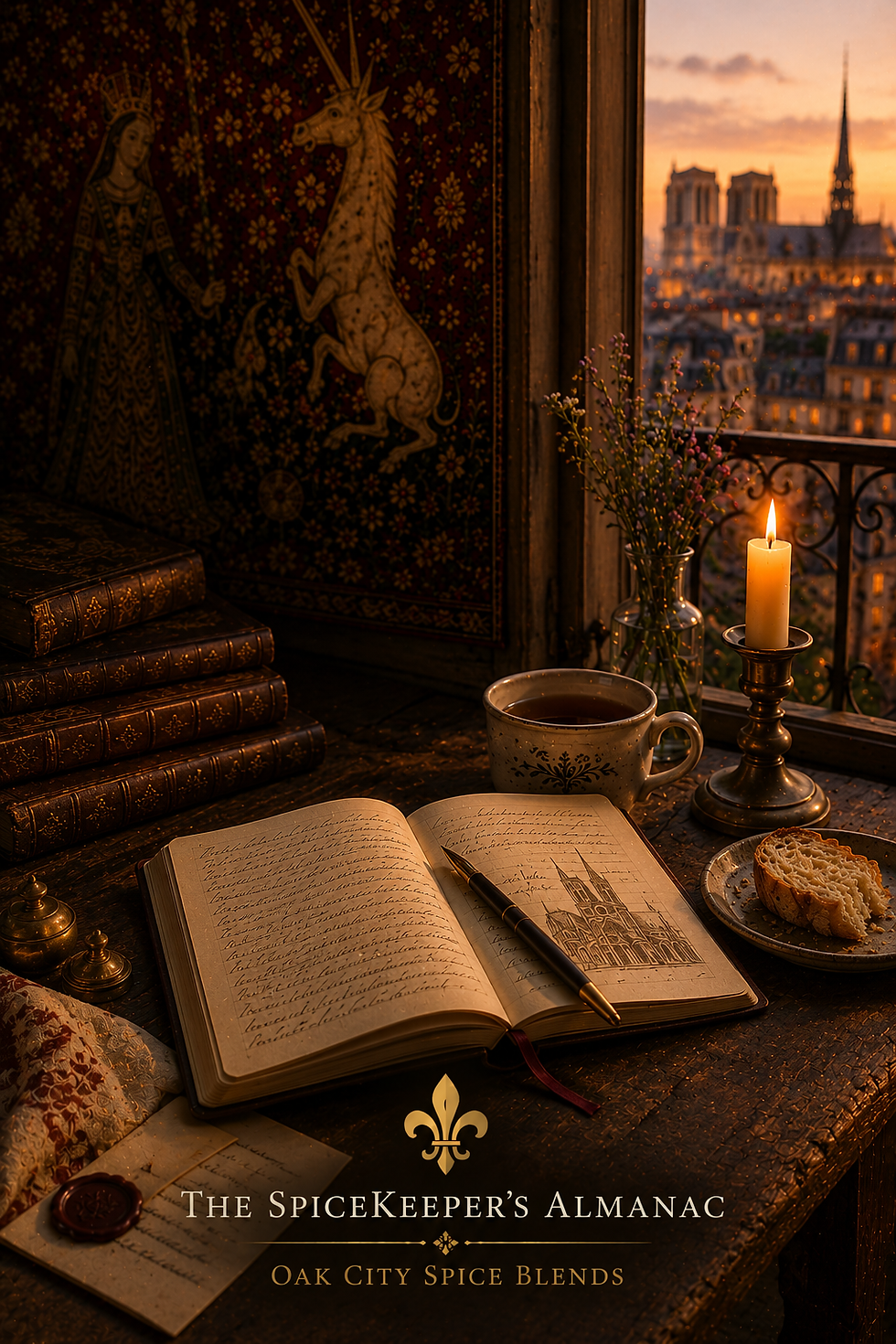
The Last Candle
The evening has grown quiet once again.
The last footsteps have disappeared into the streets of Paris. The cups have been emptied, the bread has been shared, and the candles have burned low. Only the tapestries remain, watching over the hall as they have through changing seasons, changing fashions, changing languages, and changing generations.
As I gather my notebook and prepare for our next journey together, I find myself carrying home a lesson I did not fully understand when the evening began.
The true wonder of The Lady and the Unicorn is not the unicorn at all.
It is the invitation.
An invitation to notice beauty before we hurry past it.
To prepare with care before our guests arrive.
To welcome generously without expecting anything in return.
To linger around the table long enough for conversation to become memory.
History has preserved these remarkable tapestries because they are extraordinary works of art. I hope we remember them for another reason. They remind us that the most meaningful evenings are rarely remembered for what was served. They are remembered for how they made us feel.
Hospitality is not measured by extravagance. It is measured by the care we show to those we invite to share our bread.
Perhaps that is why the finest tables in history are not the grandest ones. They are the tables where people felt seen, where laughter came easily, where stories were shared, and where everyone left believing they had been truly welcome.
If this evening has offered anything worth carrying home, I hope it is this simple thought: every meal is an opportunity to create a memory that someone else may cherish for years to come. Whether your table is humble or elaborate, whether supper is a simple bowl of soup or a feast shared with friends, kindness remains the ingredient people remember longest.
Until our next table, may your home always offer a warm welcome, your kitchen always carry the fragrance of something wonderful, and your table always have room for one more chair.
Until our next table,
Michel
The Spicekeeper
"The candle has gone out...but the table remains set for our next journey."
Dedication
This issue is dedicated to Gina (Ding Li Ying Nu Shr).
Many years ago, while serving as Laurel to my protégé, Ding Li Ying, I assigned her an illumination project inspired by The Lady and the Unicorn tapestries. The assignment was meant to explore the beauty and symbolism of medieval illumination, but she quietly discovered something deeper.
Her work captured something beyond the beauty of the tapestries themselves. She understood their gentle spirit. While many saw unicorns and flowers, she recognized the quiet invitation to wonder, kindness, and hospitality that still speaks across five centuries.
As I wrote these pages, I found myself thinking of that project and of her.
Thank you, Ding, for reminding your Laurel that the finest lessons are not always the ones we teach. Sometimes they are the ones we receive.


Comments