
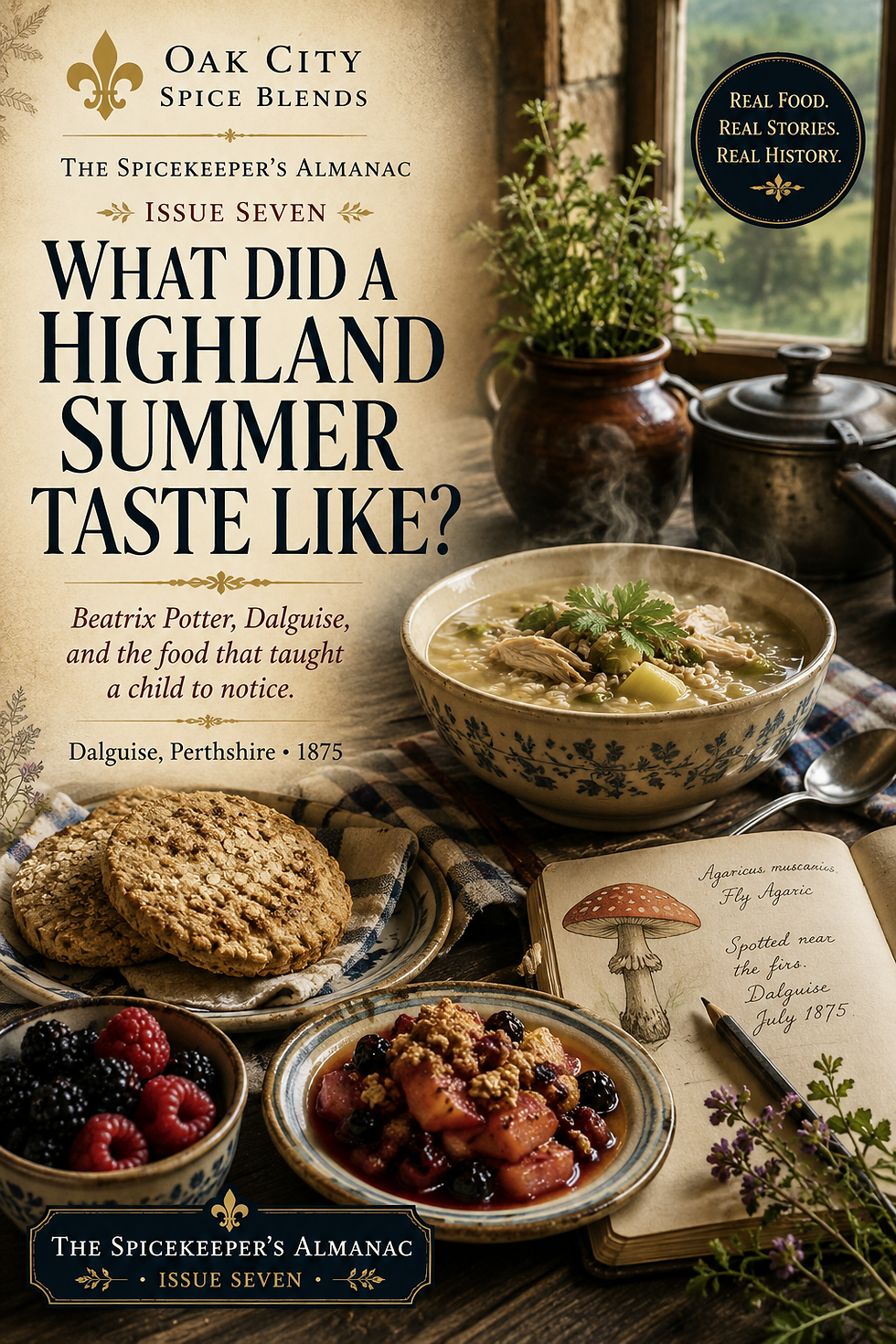
*The Governess at Dalguise, Perthshire, c. 1875 - The Spicekeeper's Almanac, Issue Seven

Updated: Jul 14
"A child who learns to look will never go hungry for wonder."
Michel
Welcome
"The finest education is rarely the one written in the lesson book."
Welcome, my friend. Come in out of the wind and find a seat by the fire.
Leave your boots by the door if they are damp. Highland summers have a habit of soaking the grass long after the rain has passed, and Cook has only just scrubbed the flagstones. There is a kettle singing softly over the range, and if you sit near the hearth, I shall pour you a cup before we begin.
Tonight I want you to meet a little girl who could spend half an hour looking at a mushroom.
Not glancing at it.
Not naming it and moving on.
Looking.
She would crouch in the wet grass until her stockings were soaked through, studying the gentle curve of its cap, the shadow beneath it, the delicate architecture of its gills. A beetle in her hand was not merely a beetle. It was a tiny marvel polished like a jewel. A rabbit was not a storybook creature, but muscle, bone, breath, and sudden motion, worth drawing again and again until the truth of it finally appeared on the page.
Her name was Beatrix Potter.
But not yet the Beatrix Potter the world remembers. Not yet the author of rabbits in blue jackets, hedgehogs carrying little laundry baskets, or ducks who trusted the wrong gentleman. Tonight she is only a quiet, watchful child of eight or nine, newly arrived from London with her family for another summer in the Scottish Highlands.
We are traveling to Perthshire, to a low white house called Dalguise that stands above the River Tay. It is the summer of 1875. Smoke curls from the kitchen chimney. The windows are open despite the cool morning air, and somewhere beyond the garden a salmon breaks the surface of the river with a splash that startles no one who lives here.
Inside, the house is comfortably busy. A woven wool blanket lies folded across the settle near the fire. Copper pans catch the morning light above the hearth. The long pine kitchen table bears the gentle marks of many years of bread dough, berry baskets, and family suppers. Boots drying by the back door tell me the children have already been outside, despite being told to wait until after breakfast.
Some things never change.
I have chosen, for this issue, to stand a little to the side of Beatrix.
I will be your governess for the season, the one who follows at an unhurried distance along the river path, who quietly notices what the children notice, and who is continually astonished by how closely this particular little girl observes the world around her. I am an imagined companion, not a recorded person. I will never place words into the mouths of those who truly lived this summer. Instead, I hope to show you what history allows us to know: where they walked, what they gathered, what they ate, and what a place like Dalguise could teach a child who was already learning to see more than most.
Because this is, at heart, a story about attention.
Most children glanced and hurried on.
This one stopped.
As I have thought about her over the years, it has occurred to me that this is the very lesson I have spent my own life trying to learn as well. The world rewards those who linger. Those who smell the herbs before chopping them. Those who taste the broth before adding another pinch of salt. Those who notice the ordinary until it quietly becomes extraordinary.
Beatrix did not know it yet, but she was already becoming a kind of keeper.
A keeper of small observed things.
So, in my own way, was I.
A low white house beside a broad Highland river. Smoke drifting lazily from the kitchen chimney. A child sitting at the water's edge, sketchbook balanced on her knees while the current slips past without hurry. This is Dalguise, and the summer of 1875 is only beginning.
Perthshire and the River Tay
To understand this summer, you must first understand the difference between two houses.
The family's true home stood in London, a tall, respectable house pressed shoulder to shoulder with its neighbors, where every room seemed to know its purpose. The nursery occupied the upper floor beneath the roof, safely removed from the drawing room below. Lessons were conducted at appointed hours. Meals appeared almost as if by magic. Voices were expected to remain gentle, footsteps light, and children pleasantly invisible until they were invited downstairs.
Then, each summer, trunks were packed, railway tickets gathered, and the family traveled north.
Everything changed.
Dalguise did not ask children to stay indoors.
The windows were opened to the Highland air. Boots gathered by the back door instead of polished neatly in the hall. Walking sticks leaned against the porch. Sketchbooks disappeared into pockets before breakfast. The house itself seemed to breathe with the countryside around it. Even indoors, one was never very far from the scent of damp earth, river water, or peat smoke drifting gently through an open window.
Perthshire in the 1870s invited curiosity.
The River Tay, the longest river in Scotland, hurried past the house, bright with salmon and trout. Ancient woods climbed the surrounding hillsides where birch, oak, and Scots pine caught the shifting light. Hedgerows bowed beneath wild raspberries, brambles, and bilberries. Rain swept across the valley without much warning, leaving everything washed clean before giving way to evenings that lingered so long in the northern light that bedtime seemed almost unreasonable.
For Beatrix, it was freedom.
She wandered with her younger brother instead of remaining within nursery walls. Together they filled cages and baskets with temporary companions, collected fossils from riverbanks, pressed flowers between heavy books, searched for beetles beneath fallen logs, and filled sketchbooks with anything that crept, hopped, flew, or bloomed.
The people around them quietly became teachers.
The gardener knew which herbs would survive the first frost. The gamekeeper could read the woods from a broken twig. The shepherd understood the weather by watching the hills. Even the cook knew which berries belonged in a pudding and which should remain where they grew.
Children who asked questions found answers everywhere.
Years later, a remarkable country postman from nearby Dunkeld named Charles McIntosh would nurture Beatrix's growing fascination with fungi, opening the door to the scientific studies that would occupy much of her young adulthood.
But that belongs to another chapter of our evening.
For now, one truth is enough.
Scotland gave her permission to notice.
The kitchen reflected that same closeness to the world beyond its walls.
In London, meals arrived from unseen hands, carried upstairs by servants the children seldom met. At Dalguise, there were no such mysteries. Salmon rested on a blue spongeware platter while it was still cool from the river. Herbs were clipped from the garden only moments before they reached the pot. Berries stained the fingers that had gathered them that afternoon. A bunch of thyme hung drying beside the hearth, and the great broth pot murmured patiently over the fire while the children wandered the woods beyond the garden gate.
Nothing felt distant.
Food belonged to the same landscape as the river, the hills, and the forest.
Looking back now, I cannot help believing that Dalguise shaped Beatrix as surely as her sketchbook did. Long before she learned to write stories, she was learning that every meal begins well before the cook lights the fire. Flavor is not something added at the end. It is grown, gathered, caught, tended, and cared for from the very beginning.
That lesson has stayed with me all my life.
Perhaps it will stay with you as well.
The Schoolroom and the River Tay
A governess comes to know a child in two very different worlds.
At the lesson table, I saw a girl who was dutiful but never entirely at ease. Morning lessons began promptly, with copybooks laid neatly across the polished table, the windows looking out toward a world far more interesting than Latin exercises or arithmetic. She completed her sums, read her passages, and learned what was expected of her. She was undeniably clever, and observant in a way that occasionally unsettled her elders, for she noticed everything and forgot very little. Yet there was always the feeling that the schoolroom fit her rather as a borrowed coat fits a growing child, proper enough, but never quite comfortably.
Out of doors, she became someone else.
By the River Tay she seemed to discover her natural measure. She would kneel on the bank until her stockings were soaked, watching the current divide around a single stone while sunlight flickered beneath the moving water. She followed animal tracks into the woods with the patience of someone twice her age, sometimes returning with muddy boots, damp cuffs, and a sketchbook filled before luncheon.
Her pages were never filled with pretty pictures meant to satisfy a drawing master. They were careful studies of things exactly as they were. A rabbit, drawn with the honesty of an anatomist. A mushroom so faithfully painted that one might almost name its species. The polished wing case of a beetle, rendered with the same concentration most children reserve for sweets. She seemed less interested in making something beautiful than in understanding it.
I taught many children over the years. Most learned to draw what they imagined they saw. Beatrix drew what was actually before her.
That is a far rarer gift.
It was not simply her pencil that worked this way.
Most children eat without asking questions. Beatrix tasted with curiosity. She wanted to know why trout from the Tay carried a flavor unlike fish from anywhere else, why yesterday's broth seemed deeper than today's, why berries gathered from a hedgerow tasted sweeter than fruit bought in the city. She asked where things came from, how they were grown, and why they changed. More importantly, she remembered the answers.
I can still picture her lingering in the kitchen doorway while Cook chopped herbs or stirred the broth, asking one more question before running back outside. The kitchen was as much a classroom as the schoolroom had ever been.
Only much later did I realize that she approached a meal exactly as she approached a sketchbook.
Both began with careful observation.
Both rewarded patience.
Both asked her to notice what others hurried past.
Perhaps that is why the Highland table suited her so perfectly. It invited questions. It rewarded attention. It reminded anyone willing to slow down that every ingredient has a story long before it reaches the plate.
I have often thought that a child who learns to notice the world rarely loses the capacity for wonder.
Nor do they ever find much satisfaction in a careless meal.
At a Highland Summer Table
Let me set the table as I remember it.
Morning light slips through the small-paned kitchen windows and catches the polished copper hanging above the hearth. The great broth pot murmurs quietly on the range. Fresh oatcakes cool beneath a folded linen cloth while someone lays a blue spongeware platter on the long pine table, ready for the salmon just brought in from the Tay. A basket of berries still carrying the scent of the hedgerow waits beside the door. Damp boots stand drying where they were abandoned, and two sketchbooks, forgotten in yesterday's excitement, rest on the settle beneath a woven Highland blanket.
This was the table at Dalguise.
The country cooking of Perthshire in the 1870s rested upon a simple, generous larder: fish from river and coast, mutton and game from the hills, oats and barley from nearby fields, fresh dairy, soft fruits, and the modest abundance of the kitchen garden. It was not a cuisine that sought to impress with costly spices or elaborate sauces. Instead, it celebrated ingredients that needed very little disguise, seasoned simply with salt, pepper, and whatever herbs the season provided.
For a child learning the world through observation, it was the perfect education.
Breakfast might begin with porridge, sometimes eaten standing in the old Highland fashion, or with oatcakes spread with fresh butter and heather honey. There were eggs when the hens were generous, fish when the river was generous, and both more often than not. As the day unfolded, the household gathered around whatever the land, river, and garden had offered.
Always, somewhere nearby, the broth pot continued its quiet work.
Bones, vegetables, herbs, and time transformed into something richer with every passing hour. The scent of simmering stock drifted through the house, mingling with fresh bread, damp wool, and the faint fragrance of thyme hanging to dry near the hearth. There was no hurry.
Anyone who came through the kitchen door hungry could be fed.
And then there were the berries.
The hedgerows around Dalguise offered wild raspberries, brambles, and bilberries in such abundance that gathering them was as much a summer ritual as a household chore. Children returned with stained fingers, scratched arms, tangled hair, and pails filled to the brim. Before evening those same berries might appear as preserves, puddings, or folded into toasted oats and fresh cream.
For Beatrix, a bowl of berries was never merely dessert.
It tasted of the walk that found them.
Looking back, I think that is why Dalguise remained so important throughout her life.
Here, food never seemed separate from the world that produced it. She watched trout lifted from the river. She gathered fruit with her own hands. She saw herbs clipped from the garden, watched bunches of parsley and thyme laid across the kitchen table, and listened to the broth quietly deepen throughout the day. Between field and table there was almost no distance at all.
A childhood like that leaves its mark.
Long before Beatrix Potter became an author, she was learning that every meal begins with careful observation. The same patience that taught her to draw a mushroom faithfully also taught her to appreciate a bowl of broth, a fresh berry, or a perfectly cooked trout.
Both began in the same place.
By paying attention.
The Lesson of Dalguise
The Lesson of Dalguise
Most of us cannot give our children the summer that Beatrix Potter was given. Few of us have a river flowing past the kitchen door, Highland hills beyond the garden, or hedgerows heavy with wild brambles waiting to stain eager hands purple. We have no gamekeeper to answer every curious question, nor a cook quietly tending a broth from breakfast until supper.
But the greatest gift of Dalguise was never Scotland itself.
It was the habit of paying attention.
It was learning that every meal has a beginning long before the cook lights the fire. It was discovering that herbs smell different when gathered in the cool of morning than they do in the warmth of afternoon. It was tasting a broth often enough to notice how time itself becomes one of its ingredients. It was understanding that food is not simply eaten. It is first grown, gathered, caught, prepared, shared, and remembered.
Those lessons belong to no particular place. They begin wherever a child helps snip herbs from a windowsill pot, gathers tomatoes warm from the garden, watches onions soften slowly in butter, or stirs a soup that fills the whole house with its fragrance. They begin whenever we slow down long enough to ask where our food came from, who grew it, and who placed it before us.
That is the table I hope we continue to build.
The recipes that follow are not museum pieces, nor are they exact recreations of one family's meals. They are honest dishes inspired by the spirit of a Highland summer table, adapted for today's kitchen and built around three Oak City Spice Blends that capture the herb-and-allium character of that cooking: a broth that rewards patience, a bird meant for sharing, and a pudding that tastes of an afternoon outdoors.
As you prepare them, resist the temptation to hurry. Lift the lid now and then. Taste before seasoning again. Notice how the herbs change as they bloom. Watch the broth grow deeper. Cooking has always rewarded those who pay attention.
That, I think, is the finest way to honor the little girl who knelt beside the River Tay with a sketchbook in her lap, determined to understand the ordinary world before moving on.
History is at its richest when we can taste it.
Perhaps tonight, around your own table, you will discover that the smallest observations often become the memories that last the longest.
From the Spicekeeper's Kitchen
Three Recipes from a Highland Summer
"History tells us what people cooked. The kitchen teaches us why those dishes endured."
The stories we inherit are only half the journey. The other half begins when we light the stove.
The recipes that follow are inspired by the food of a Highland summer table at Dalguise around 1875. They are not museum reconstructions, nor are they modern inventions dressed in old clothes. Instead, they are honest adaptations, built from the ingredients, techniques, and rhythms of nineteenth-century Scottish country cooking, then gently translated for today's kitchen.
Each recipe uses the Bloom Method, the simple practice of awakening dried herbs and spices in warm fat or gentle dry heat before the remaining ingredients are added. Blooming releases the essential oils locked within dried herbs and spices, creating fuller aromas and deeper flavor. It is a small step, but one that consistently transforms both historical dishes and everyday meals.
The Highland table was never defined by an overflowing spice cupboard. It was shaped instead by onions and leeks, parsley and thyme, fresh butter, slow-simmered broth, oats, and patient hands. Where I have chosen to introduce a modern Oak City Spice Blends seasoning to capture that same herb-and-allium character, I have noted the departure openly. History deserves honesty, and good cooking welcomes it.
These three recipes follow the quiet rhythm of a single Highland day. The first is a broth that waits patiently on the stove. The second is a bird meant to gather family and friends around the table. The third is a warm pudding that carries the memory of an afternoon spent among the brambles.
Whether you prepare one recipe or the entire meal, I hope they encourage you to cook a little more slowly, taste a little more thoughtfully, and notice the small changes that happen along the way. Lift the lid from the broth now and then. Smell the herbs as they bloom in the butter. Taste before reaching for more seasoning.
Those are small acts.
They are also the very lessons a quiet little girl beside the River Tay was learning long before she ever wrote her first story.
May these recipes bring a little of that Highland summer to your own table.
Morning
The Broth That Waited
Highland Hotch-Potch with Garden Alliums and Barley
"No meal says 'someone expected you to come home' quite like a broth waiting quietly on the stove. In a Highland kitchen, the broth pot was rarely empty. Every hour deepened its flavor, and every visitor knew a warm bowl would be waiting."
Historical Notes
Hotch-potch has appeared on Scottish tables for centuries, changing with the seasons and whatever the garden or pasture provided. Spring versions were filled with young vegetables, while later summer pots welcomed barley, mature roots, and sturdy greens. No two households prepared it exactly alike, which was part of its charm.
Featured Blend: Wilde Garlek
Bloom Classification: Fat Bloom
Why the Bloom Works
Blooming Wilde Garlek in butter gently awakens its roasted garlic, onion, and chive before the vegetables are added. Rather than sitting on top of the soup, those flavors become part of the broth itself, echoing the allium-rich cooking of a nineteenth-century Highland kitchen.
Ingredients
1½ lb mutton or lamb neck, bone-in (680 g)
2 Tbsp butter (30 g)
1 Tbsp Wilde Garlek (9 g)
½ cup pearl barley, rinsed (100 g)
2 carrots, diced
1 small swede or turnip, diced
1 leek, sliced
2 cups shredded cabbage or kale (140 g)
8 cups water (1.9 L)
Salt to taste
Chopped parsley, to finish
Method
Cover the mutton with the water, bring to a gentle simmer, and skim. Cook low for about 1½ hours, never letting it boil hard, until the meat loosens from the bone.
Lift out the meat, shred it from the bone, and set aside. Keep the broth.
In the same pot, melt the butter and bloom the Wilde Garlek in it for about 30 seconds, until the alliums smell sweet and toasted.
Add the rinsed barley and the carrots, swede, and leek. Pour the broth back over, and simmer 1 hour until the barley is tender and the broth has body.
Return the shredded meat, add the cabbage, and simmer 15 minutes more. Season with salt, finish with parsley, and serve.
Best With: Warm oatcakes and a wedge of crowdie or farmhouse cheese. Better still the next day.
Blooming Notes: Wilde Garlek is all allium and chive, so blooming it in butter before the barley goes in lays down the savory base the whole pot builds on. Do not let it brown past golden, or the garlic turns bitter.
Midday
The Long Table Bird
Cock-a-Leekie with Sage and Thyme
"The River Tay offered salmon and trout, but the farmhouse chicken remained one of the quiet centerpieces of the Highland table. Simmered slowly with leeks and herbs, it was generous food, meant to bring everyone together."
Historical Notes
Cock-a-leekie is one of Scotland's oldest soups. Earlier versions relied almost entirely on chicken and leeks, while Victorian cooks often added barley or rice to make the meal more substantial. Prunes, surprising to many modern diners, were a traditional garnish that added gentle sweetness to the rich broth.
Featured Blend: Poultry Party
Bloom Classification: Fat Bloom
Why the Bloom Works
Blooming the blend in butter allows the sage and thyme to release their essential oils before the broth is added. Without this step, dried herbs remain muted in a simmered dish where they never experience the dry heat of roasting.
Ingredients
1 whole chicken about 4 lb (1.8 kg)
2 Tbsp butter (30 g)
1 Tbsp Poultry Party Seasoning (8 g)
4 leeks, sliced into thick rounds
½ cup pearl barley or long-grain rice (100 g)
8 cups water or light stock (1.9 L)
6 to 8 prunes, optional but traditional
Salt and pepper to taste
Method
Melt the butter in a large pot and bloom the Poultry Party for 30 seconds, until the sage and thyme open up.
Add half the leeks and soften them in the spiced butter for a few minutes.
Set the whole bird in the pot, pour over the water, and bring to a gentle simmer. Cook low for about 1½ hours, skimming, until the fowl is tender.
Lift the bird out, take the meat off the bone, and return the meat to the pot. Add the barley and the remaining leeks.
Simmer 30 minutes more. Add the prunes for the last 10 minutes if using, season, and serve in deep bowls.
Best With: Bread to sop the broth. The prunes are the old Scots touch and worth keeping.
Blooming Notes: Poultry Party is a sage-forward roast-bird blend, so the fat bloom is what carries it into a simmered dish like this one, where there is no roasting step to wake the herbs. Bloom it first, or the sage stays flat.
Evening
The Bramble Walk
Baked Brambles and Apples with a Spiced Oat Crust
"The children returned from the hedgerows with stained fingers, scratched sleeves, and baskets heavy with fruit. By evening, those same berries had become dessert."
Historical Notes
The fruit is entirely at home on a Victorian Highland table. The warm spice blend is not. Scottish cooks of the period would have relied primarily on the fruit itself, perhaps with a little sugar and cream. The gentle spices here are a modern interpretation inspired by the season rather than a historical reconstruction.
Featured Blend: 1st Day of Autumn
Bloom Classification: Dry Bloom
Why the Bloom Works
Toasting the spice blend with the oats awakens both at the same time. The oats become nuttier while the spices release their fragrance, creating a crust with far greater depth than either ingredient could achieve alone.
Anachronism flag: the warm-spice blend here (cinnamon, ginger, nutmeg, clove, vanilla) is a modern Oak City Spice Blends touch. A true Dalguise pudding would have leaned mostly on the fruit and a little sugar; the spicing is ours, not the 1870s kitchen's.
Ingredients
3 cups brambles/blackberries and bilberries or blueberries (450 g)
2 apples, peeled and sliced
3 Tbsp sugar, plus more to taste (40 g)
1½ tsp 1st Day of Autumn (4 g)
1 cup rolled oats (90 g)
½ cup flour (60 g)
¼ cup brown sugar (50 g)
6 Tbsp cold butter, cubed (85 g)
Pinch of salt
Method
Toss the berries and apple slices with the white sugar and ½ tsp of the 1st Day of Autumn. Spread in a buttered baking dish.
In a dry pan, warm the oats over low heat with the remaining 1 tsp of 1st Day of Autumn for a minute, until fragrant. This is the dry bloom.
Tip the toasted oats into a bowl with the flour, brown sugar, and salt. Rub in the cold butter with your fingertips until crumbly.
Scatter the crust over the fruit. Bake at 375°F (190°C) for 30 to 35 minutes, until the top is golden and the fruit bubbles at the edges.
Serve warm, with cream or fresh crowdie.
Best With: A jug of thick cream.
Blooming Notes: Toasting 1st Day of Autumn into the oats over dry heat is the cleanest way to bloom a sweet blend. It blooms the spice and toasts the oat in one step, so the crust tastes of both.
Michel's Notebook
As I closed my notebook this evening, I found myself thinking about the postman. Not because he delivered letters, but because he delivered knowledge.
Near Dalguise lived a country postman named Charles McIntosh, a gifted naturalist who knew the fungi of the Perthshire woods better than almost anyone of his day. Years after the summer we have shared tonight, when that observant little girl had grown into a young woman, he became her teacher. Together they explored the hidden world beneath the trees. I like to imagine the old postman's satchel carrying more than letters on those walks, with a notebook tucked beside the day's post and perhaps a curious mushroom wrapped carefully in paper, waiting to be identified before evening fell.
Beatrix painted hundreds of mushrooms with such scientific accuracy that mycologists still study her illustrations today. She developed her own theory of how fungi reproduce and prepared a scientific paper describing her work. It was presented to a learned society on her behalf because, as a woman, she was not permitted to read it herself.
History remembers that disappointment.
I wonder if history remembers what it could not discourage.
She turned her careful eye toward stories instead. The same patience that had lingered over mushrooms now lingered over rabbits, hedgehogs, ducks, mice, and frogs. She became one of the best-selling children's authors in history, a successful farmer, conservationist, and businesswoman who quietly insisted on directing her own work with remarkable independence.
The science was never lost.
Neither was the looking.
What Beatrix Potter learned beside the River Tay was never simply botany, drawing, or even cookery. She learned the discipline of attention. She learned to remain with an ordinary thing until it revealed something extraordinary. She discovered that wonder rarely belongs to those in a hurry. She carried that habit into every part of her life: into her paintings, into her stories, into her farms and her beloved Lakeland countryside, and, I have little doubt, into her kitchen.
That is why her story stays with me.
Nearly forty years ago, my daughter's grandmother gave her a small children's tea set decorated with Peter Rabbit and his companions. She had lived in Scotland, Wales, and Africa, and those English stories were part of the world she carried with her. The gift was not grand, but it became part of childhood in our house: tiny cups, tiny saucers, and countless imaginary teas where stories were poured as generously as the make-believe tea itself.
That little tea set still lives with us.
Only now do I realize that Beatrix Potter had already found a place at my family's table long before I ever began researching Highland kitchens or writing these pages. Her stories crossed countries and generations in the quiet way beloved stories often do, carried from one grandmother's hands to a child's tea table, then remembered years later by someone closing a notebook beside the fire.
Perhaps that is one measure of a true storyteller.
Long after the last page is turned, they are still quietly sitting at the table with us.
I have spent much of my own life keeping small observed things. Sometimes it is a forgotten recipe tucked into the margin of an old cookbook. Sometimes it is a spice mentioned only once in a centuries-old manuscript. Sometimes it is discovering that one more quiet minute of blooming transforms a familiar seasoning into something entirely new. My own notebooks have become filled with those observations, scribbled beside recipes and measurements, each one another small reminder that the ordinary still has something to teach us if we are willing to pay attention.
I study those things until I believe I understand them. Then I share what I have learned, holding nothing back, in the hope that someone else will discover the same delight.
Perhaps that is the real work of a Spicekeeper.
Not merely collecting recipes.
Teaching people how to notice.
I never met Beatrix Potter. She belonged to another century, and our paths could never have crossed. Yet on evenings like this one, when the fire has burned low and my notebook is ready to close, I feel a quiet kinship with that child kneeling beside the River Tay, her stockings soaked through as she studied a single mushroom.
She believed it was worth looking closely.
After all these years, I believe she was right.
It always is.
Further Reading
If this evening has encouraged you to spend a little more time with Beatrix Potter and the Scotland that shaped her, these are the books I would place into your hands first.
Beatrix Potter: A Life in Nature
Linda Lear (2006) The definitive modern biography of Beatrix Potter, with particular attention to her scientific work, her lifelong observation of the natural world, and the experiences that shaped both her art and her conservation efforts. ISBN: 9780312377960
Beatrix Potter's Gardening Life
Marta McDowell (2013) A beautiful exploration of Potter's gardens, landscapes, and deep connection to the living world. It offers wonderful insight into the plants, seasons, and places that quietly influenced her stories. ISBN: 9781604693638
The Journal of Beatrix Potter, 1881–1897
Transcribed by Leslie Linder (Revised Edition, 1989) Written in Potter's own coded journal and later deciphered by Leslie Linder, these pages introduce us not to the famous author, but to the thoughtful, curious young woman she was becoming. Reading her own words is one of the finest ways to understand the mind behind the stories. ISBN: 9780723236252
Exploring the Highland Table
For readers interested in the food itself, the National Library of Scotland and the National Trust for Scotland both offer excellent articles, historical collections, and museum resources exploring nineteenth-century Scottish country life, regional cookery, and the everyday rhythms of Highland households.
Continue the Journey
Every issue of The Spicekeeper's Almanac begins with a place.
I hope each one ends with an invitation.
Most of us will never spend a summer beside the River Tay. We may never fill a basket with wild brambles from a Highland hedgerow or watch salmon lifted from Scottish waters.
But the true gift of Dalguise was never its location.
It was learning to pay attention.
Taste the broth before it is finished, and then taste it again an hour later.
Rub a sprig of thyme between your fingers before it reaches the pot.
Ask where your ingredients came from.
If there is a child in your life, invite them into the kitchen and let them ask questions. Better yet, let them discover a few answers for themselves.
These seem like small things.
They are, in truth, the whole of it.
When the meal is finished, resist the urge to hurry away.
Linger over the last spoonful of pudding, the last splash of cream, the conversation that begins after the plates have been cleared. Some of the richest moments around a table arrive only after supper is over, when no one is watching the clock and everyone has forgotten to be in a hurry.
That is the gift Beatrix Potter carried from Dalguise into the rest of her life.
She learned that the ordinary world, patiently observed and generously shared, is extraordinary enough.
I think the same is true of a well-loved kitchen.
Until our next table, may your hands never lose their curiosity, may your kitchen always carry the fragrance of something prepared with care, and may there always be room for one more chair.
Michel
The Spicekeeper
"The fire has burned low, but the river still runs... and the next journey is already waiting."
A Note on This Issue
Beatrix Potter was a real person, and the summers her family spent at Dalguise beside the River Tay are well documented, as are her lifelong habits of close observation, her scientific studies of fungi, and her friendship with the Perthshire naturalist Charles McIntosh, who became one of her teachers.
The governess who accompanies this issue is entirely imagined.
She was created as a storyteller's companion, someone who could quietly walk beside the historical record without speaking for the people who truly lived it. Whenever this Almanac describes places, foods, customs, or documented events, it is grounded in historical research. Whenever the governess reflects upon those experiences, she does so as a fictional guide whose purpose is to help us see the past a little more clearly, never to replace it.
History deserves honesty.
Stories deserve imagination.
The Spicekeeper's Almanac is written with both.


Comments